
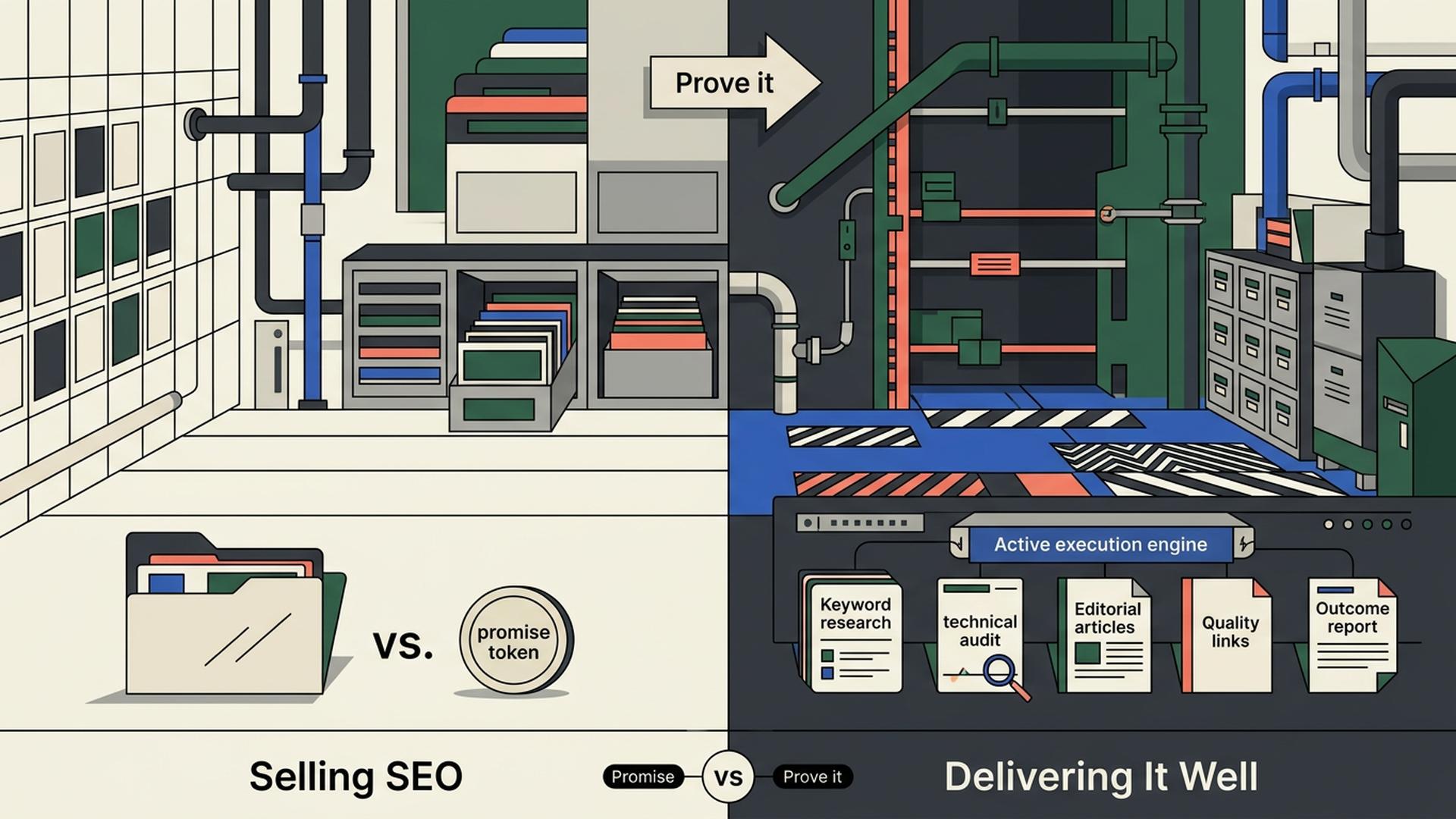
The Difference Between Selling SEO and Delivering It Well
You can sell SEO in a single call, but you can’t deliver it with a single tactic. It’s easy to promise “more traffic and leads” when you’re not the one untangling bad site architecture, thin content, and weak links for months. The gap between the pitch and the work is where trust breaks or compounds. If you want SEO clients to stay, you have to rethink how you frame the offer from day one…
Why Selling SEO Is Easy But Delivering It Is Hard
On the surface, selling SEO can seem straightforward because it centers on a clear value proposition: increased visibility and traffic over time.
This concept is easy to communicate in a brief presentation, but executing on it's complex and resource-intensive.
Performance depends on factors such as the client’s business model, website structure and technical health, content quality, competitive landscape, search demand, and existing domain authority.
There is also a structural mismatch between sales incentives and SEO delivery.
Sales processes typically reward fast deal closure, while meaningful SEO outcomes often require 6–9 months or more to materialize.
This gap can encourage reliance on appealing but shallow solutions, such as generic AI-driven dashboards or broad “visibility” metrics that lack clear ties to business outcomes.
Without validated strategies, concrete assets (such as high-quality content and technical improvements), and realistic timelines, the sales promise can exceed what the delivery team can reliably achieve and measure.
The gap usually widens fastest when sales outpaces production capacity the deal closes, and then the work queues behind three other accounts. Some agencies close that gap by keeping a white label SEO partner in place for content, links and local work, so that signing a new client doesn't depend on whether a writer is free that fortnight. The point isn't outsourcing for its own sake; it's that the promise you make on the call should be backed by capacity you already have, not capacity you intend to hire.
Common False Promises In SEO Sales (And Their Cost)
Sales conversations about SEO often move into problematic territory when they rely on promises that sound precise but can't be controlled or guaranteed.
“Guaranteed rankings” overlook that search algorithms evaluate hundreds of evolving signals, and “instant results” disregard the typical 6–9 month cycle required for implementation, testing, refinement, and re-indexing.
Committing to specific timelines before completing audits and establishing baselines ignores potential technical issues, content gaps, and implementation bottlenecks that can delay progress.
Presenting “AI search visibility” as a predictable outcome is similarly misleading, as AI-generated answers and result formats are still changing and largely outside an individual site’s direct control.
Focusing on traffic growth without connecting it to leads, revenue, or other business metrics shifts attention to vanity indicators rather than measurable business outcomes.
What Great SEO Delivery Looks Like Day To Day
When you set aside inflated promises, effective SEO work functions as a structured, ongoing process rather than a one‑time project. You plan, implement, measure, and refine in a continuous cycle.
On a day‑to‑day basis, you monitor key baselines such as organic traffic, qualified leads, and conversions and adjust objectives as you progress from resolving technical issues (indexing, crawlability, and click‑through rates) to developing content hubs, improving topical authority, and earning relevant links.
Weekly, you record what was changed, review the resulting data, and avoid making untested changes based on assumptions.
You also note external factors, including confirmed Google updates and observable shifts in competitor activity.
For local businesses, you manage review volume and velocity to support local search visibility, ensuring reviews are authentic and policy‑compliant.
Throughout, you rely on tools such as Google Search Console and Google Analytics (or comparable analytics platforms) to verify which initiatives are contributing to performance and to prioritize the next set of technical, content, or off‑page improvements.
How To Pitch SEO Timelines Against Faster Channels Like Cold Email
Instead of avoiding the “how long will SEO take?” question, position SEO alongside faster channels such as cold email so prospects understand the trade‑offs.
Clarify that cold email can generate conversations with decision‑makers within weeks because it allows direct outreach, rapid changes to targeting and messaging, and quick adjustments to sending volumes and domains.
Then contrast this with SEO’s typical 6–9 month ramp.
Explain that search performance improves through iterative work across content, links, and technical elements: create, test, measure, and refine.
Use trust‑signal examples such as ~10 new reviews per week often being more persuasive than hundreds of outdated reviews to illustrate why building credibility and rankings requires time.
Finally, distinguish between “visibility” (impressions and traffic growth) and “revenue” (closed deals or qualified pipeline) so expectations around SEO timelines remain realistic and transparent.
How To Sell SEO Without Overpromising Results
Although it may be tempting to sell SEO with bold promises and firm guarantees, this approach often leads to unstable engagements and dissatisfied clients.
Avoid promising specific rankings or “guaranteed” outcomes, as search performance depends on many external factors, including ranking signals, competitor activity, and ongoing algorithm updates.
A more sustainable approach is to emphasize your methodology and the likelihood of different outcomes.
Clarify that measurable improvements typically emerge over a period of 6–9 months, depending on the site’s current state and the competitiveness of the industry.
Establish shared responsibility from the start: your recommendations are only effective if the client implements necessary technical, structural, and content changes.
Refrain from using alarmist, AI‑related messaging or any language that resembles guarantees.
Instead, rely on current benchmark data, define realistic performance ranges, and clearly communicate the assumptions behind your projections rather than specifying exact future traffic or lead numbers.
Show Clients the Real ROI of Your SEO Work
Because SEO outcomes can seem abstract to non‑marketers, it's important to translate activity into measurable financial impact from the outset. Begin by establishing baselines such as current organic traffic, qualified leads, and conversion rates.
From there, define specific, time‑bound targets (for example, “increase organic traffic by 50% in 6 months”) and model how these changes could affect lead volume and projected revenue.
Present results in business terms: inquiries, booked appointments, sales pipeline, and closed revenue. Keyword rankings and visibility metrics are indicators of progress, but they aren't substitutes for demonstrating financial return.
Incorporate clear conversion and revenue assumptions into every proposal so expected returns are transparent.
Compare SEO’s potential for compounding, long‑term gains with SEM’s dependence on continuous cost‑per‑click (CPC) spend, and explain how factors such as content quality, domain authority, and user engagement can contribute to sustained performance over time.
Using Trust, Reviews, and Local Signals To Power SEO
Building trust online is now as important as any technical SEO adjustment.
Beyond aiming for high ratings, businesses need to demonstrate reliability in ways that are clear to both search algorithms and potential customers.
Review activity and freshness matter: a steady stream of recent, authentic reviews can be more influential than a large number of older, inactive ones.
Request reviews soon after a service is completed, ideally within about 30 minutes, when the experience is still top of mind.
Simplify the process by sending a brief, personalized message that includes a direct link to your Google review page.
When feedback is negative, respond promptly and professionally: acknowledge the customer’s experience, accept responsibility where appropriate, and move the detailed resolution to a private channel.
Monitor review patterns over time, including volume, recency, rating trends, and the language customers use.
Treat reviews and other local signals such as Google Business Profile activity, local citations, and engagement metrics as part of a dynamic system that requires ongoing attention and refinement.
Align Your Sales Process With Long-Term SEO Success
Trust signals and local visibility provide the most value when your sales process reflects how SEO performs over time.
Set realistic expectations about traction: meaningful, defensible gains typically appear over a 6–9 month period, not in a few weeks.
Qualify prospects based on budget, access to decision-makers, and their capacity and willingness to implement on-page and technical changes.
Without execution on their side, your recommendations will have limited impact.
Clearly document expectations and governance: you can't guarantee specific rankings, and several milestones will depend on timely feedback, content approvals, and development support from their team.
Position SEO as a continuous cycle of creating, testing, measuring, and refining.
Involve delivery or implementation specialists within the first 90 days to confirm operational fit, surface constraints early, and reduce the risk of misalignment between sales promises and actual delivery.
A Simple Account Management Process That Keeps SEO Clients Long Term
Once a prospect becomes a client, a clear and consistent account management process is often more important than any single SEO tactic. In the first month, establish shared expectations that significant organic performance improvements typically appear after 6–9 months, then refine that forecast as actual performance data accumulates.
Define and document the scope of work, including the client’s responsibilities such as website updates, access provisioning, and implementation support. This reduces the risk of misalignment between what sales discussed and what the delivery team can execute.
Maintain a structured “request and action” workflow to ensure tasks are clearly assigned, tracked, and completed. For local SEO, this can include a systematic review-generation process, such as consistently requesting reviews shortly after each completed job.
Use monthly reports that connect activity to outcomes, focusing on metrics like organic traffic, lead volume, and revenue where available. Pair these reports with a structured issue–response loop: identify problems, document their likely causes, define corrective actions, and track whether those actions produce measurable improvements over time.
Conclusion
When you sell SEO honestly and deliver it rigorously, you stop gambling with churn and start compounding trust, rankings, and revenue. Set timelines against reality, not pressure. Show leading indicators, not just lagging wins. Tie every task to ROI, not vanity metrics. If you align your pitch, process, reporting, and account management, you’ll keep clients longer, command higher retainers, and build a reputation that quietly sells your next engagement for you.